







Avalara powers millions of businesses worldwide
- Automated creation and transmission of mandate-compliant e-invoices
- Support for clearance, real-time reporting, and centralized and decentralized CTC models
- Built-in handling of digital signatures, QR codes, PDFs, and archiving
- Accreditation with local tax authorities
- Single, cloud-native global API
- Prebuilt ERP connectors (SAP, Oracle, NetSuite, Microsoft, Workday, and many more)
- Self-service activation of new mandates via user console
- Continuous regulatory updates managed centrally
- AI-assisted monitoring and analytics where you do business
- Full audit trails across inbound and outbound invoices
- Unified receipt and transformation of incoming e-invoices into XML
CUSTOMERS




Create and send invoices, credit notes, and other documents in locally compliant formats — and transmit them to tax authorities automatically, across clearance, reporting, and CTC models.
Validate invoice data with XSD and Schematron checks before submission to catch errors early and avoid delays, audits, and penalties.
Handle local archiving, QR codes, PDFs, and other country-specific requirements from a single platform — without rebuilding workflows for each market. This means you can activate new countries without new integration projects.
Apply digital signatures to protect invoice integrity, meet regulatory requirements, and build trust with trading partners.
Receive incoming e-invoices in any mandated format and transform them into a unified structure to automate accounts payable processing.
Deploy across multiple countries with a centralized service that adapts to local regulations including receiving, validation, responses, and audit evidence, not just sending invoices — helping you stay ahead as mandates evolve.
Turn on additional country mandates through self-service configuration — reducing reliance on development and speeding up expansion.
Track invoice status, performance, and issues in real time through a centralized portal — with full visibility across markets.
Capture every action across inbound and outbound invoices to support compliance, transparency, and audit readiness.
Connect seamlessly with government systems through locally accredited solutions that support compliant e-invoicing across jurisdictions.
Send and receive documents via Peppol, DBNA, and local exchange networks — ensuring standardized, compliant data exchange worldwide.
Automatically adapt to changing e-invoicing and reporting requirements — without manual updates or ongoing maintenance.
Operate on a multitenant cloud platform with automatic updates, zero downtime, and built-in recovery to keep transactions flowing.
Meet global security benchmarks with ISO 27001 and SOC 2 Type II certification — ensuring the integrity, availability, and protection of your data.
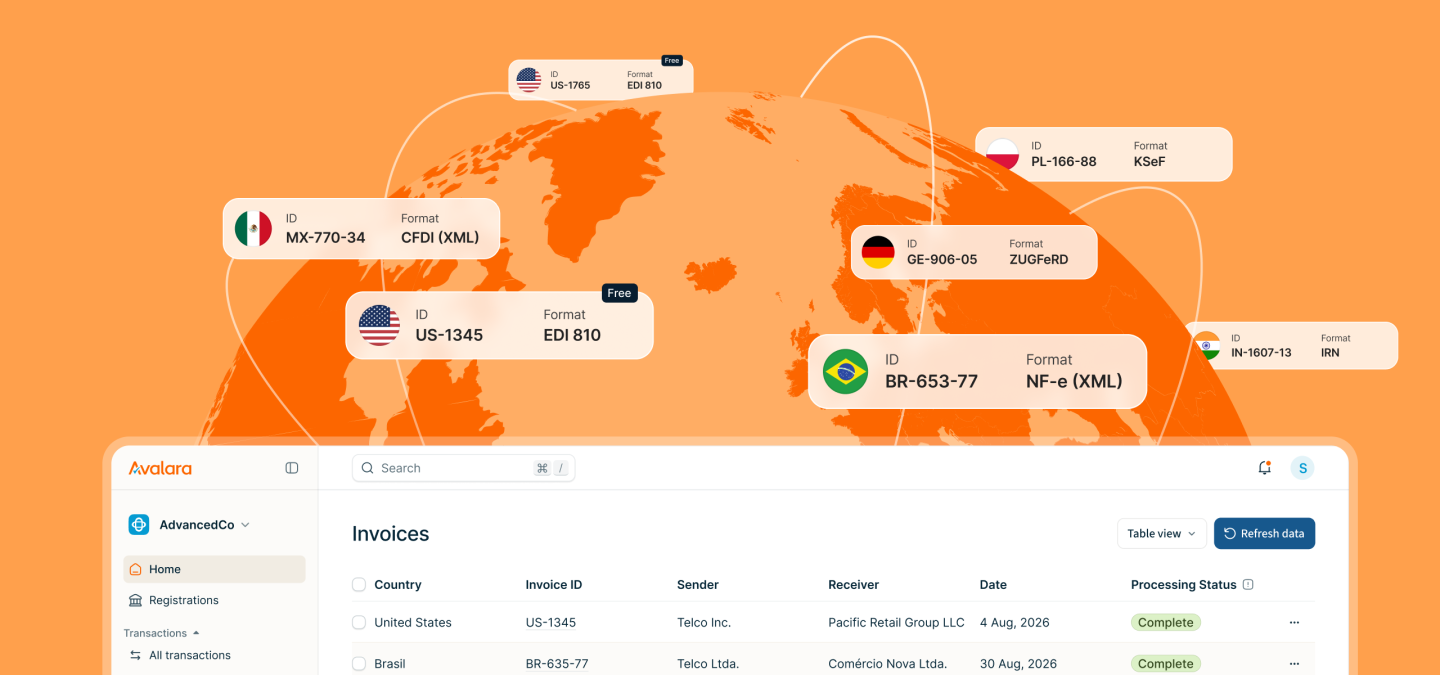
Avalara E-Invoicing and Live Reporting is an agentic e-invoicing solution that can simplify compliance processes for companies operating internationally. It can be integrated into business systems via a single application programming interface (API), and is designed to adhere to evolving e-invoicing and live tax reporting requirements in different countries. This enables businesses to exchange e-invoices and report data in real time via tax authorities’ platforms and exchange networks.
Many providers use outdated EDI or closed networks. Avalara uses a modern, open network with a single global API — solving both scalability and connectivity challenges in one unified solution.
Avalara is also recognized by IDC as a leader for its tax technology as well as e-invoicing proficiency. Read the report.
This unique combination enables businesses to establish billing processes that are compliant end to end, whether it’s generating invoices with more accurate local tax rates and transmitting them as e-invoices via local government-mandated platforms and e-invoice exchange networks or digitally reporting data to tax authorities in the required formats and timelines.
Multiplatform integrations can result in inconsistent features, multiple user interfaces, extra integrations, and increased maintenance. This makes it harder to scale, harmonize, or upgrade across countries.
Avalara E-Invoicing and Live Reporting integrates into business transaction systems like ERP and ecommerce platforms and operates seamlessly in the background without disrupting user workflows.
To gain insights into the e-invoicing process, users can access monitoring and analytics tools through an intuitive interface or leverage the functionality available within their business applications.
Yes. Every Avalara customer gets access to sandbox accounts — connected to government test systems where possible. You can test pre- or post-go-live independently and without added cost.
Our open network model allows seamless access to over 50 million trading partners and with government and tax authority platforms, portals, and networks — helping you scale faster without complex integrations or manual trading partner onboarding.
Avalara E-Invoicing and Live Reporting is designed to comply with local tax reporting requirements including real-time reporting, support for clearance models, centralized invoice creation models, and other country-specific rules.
As a certified Peppol Access Point service provider, Avalara offers clients access to the Peppol network in European countries, Australia, New Zealand, Malaysia, and Japan. Avalara is also a certified provider for the new DBNA network in the U.S. and facilitated the first e-invoice transmission over this network.
Avalara E-Invoicing and Live Reporting is tailored to meet the unique e-invoicing and live reporting requirements of each supported country mandate, including support for digital signatures, QR codes on invoices, and in-country invoice storage.
