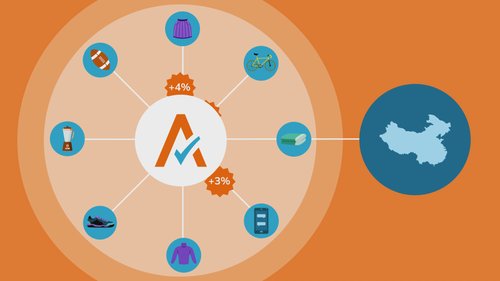
Video: Avalara Cross-Border helps you navigate the complexities of global commerce.
Trusted by companies in every industry

Uncomplicate cross-border trade and tariff compliance
Complete the form to connect with an Avalara global trade compliance expert.
Here's what happens after you submit:
A specialist will reach out to discuss how Avalara cross-border solutions can fit your needs.
We’ll review your international business plans and compliance goals.
You’ll learn how you can use software to automate landed cost calculations, improve the customer experience, and reduce compliance risk.
Connect with us now — we’re excited to speak with you! Already a customer? Get technical support.
BENEFITS
Your end-to-end solution for international trade compliance
Accelerate Trade with Agentic AI
Avalara MCP servers embed compliance intelligence into ERPs, ecommerce, and supply chains to streamline cross-border compliance. Learn more
Simplify global transactions
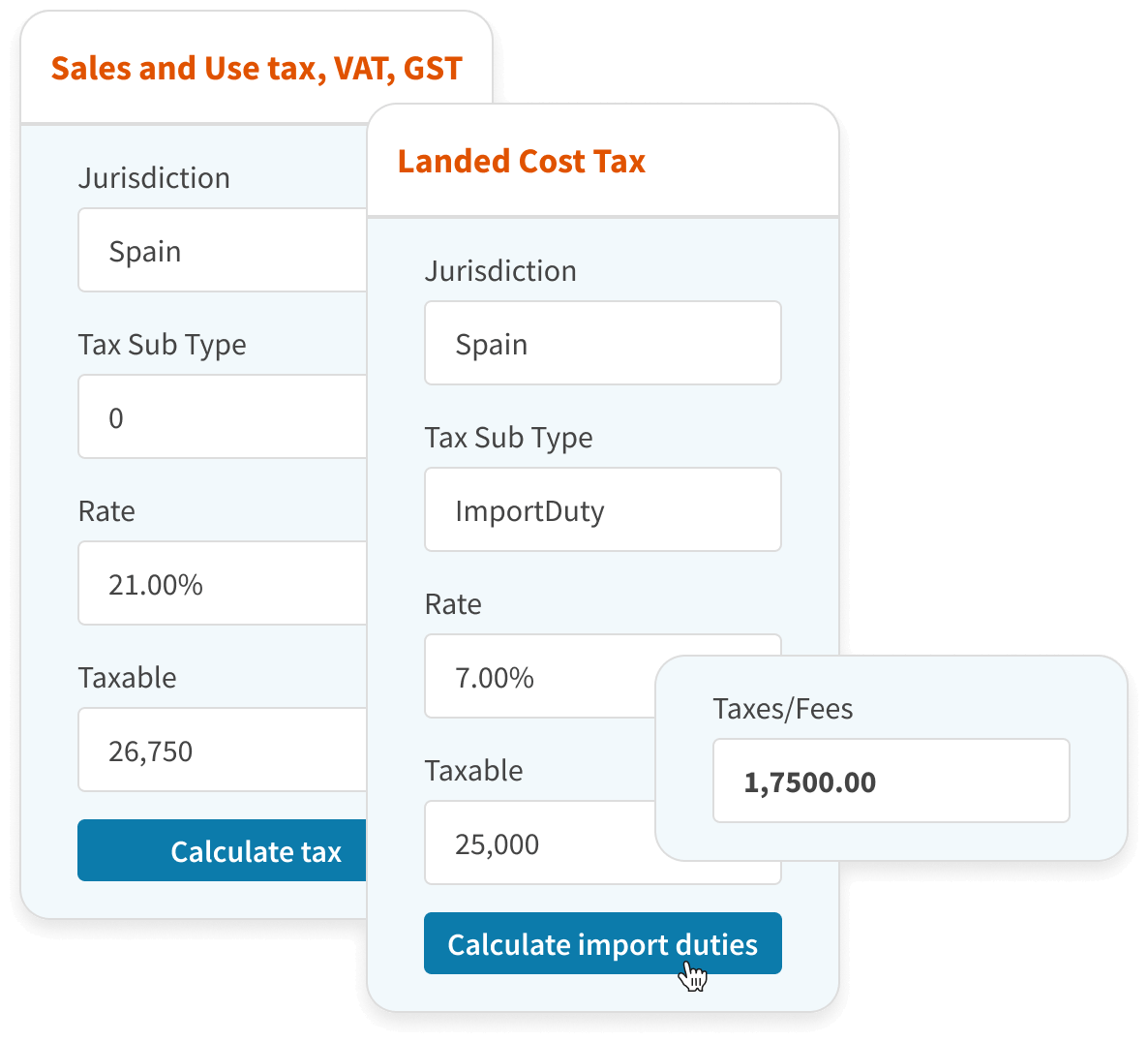
Unify the calculation of customs duties and import taxes, VAT, GST, and sales and use tax from a centralized platform.
Improve customer experience
Take advantage of preferential and punitive government treaties to access lower rates, offer more competitive pricing, and reduce customer churn.
Calculate customs duties in real time
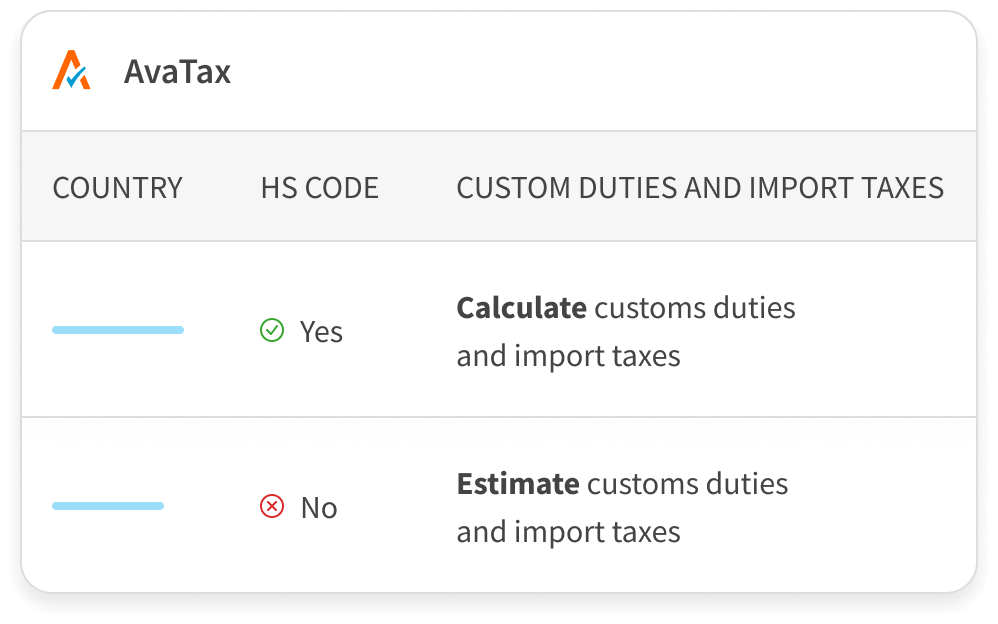
Collect customs duties and import taxes at checkout (even when HS codes aren’t available) to preserve transparency and avoid cart abandonment or refused packages.
Preserve and enhance margins
Ensure duty calculations collected from customers at the online point of purchase cover downstream duty charges imposed by customs agencies.
Connect with classification solutions
Leverage Avalara Tariff Code Classification for more accurate and efficient assignment of HS, HTS, and Schedule B codes.
How it works
AvaTax global calculations
Provide your product catalog with HS-6 or HS-10 classifications or item descriptions, listing details, and destination countries.
Connect to your ecommerce or ERP systems with our prebuilt integrations, or through our API.
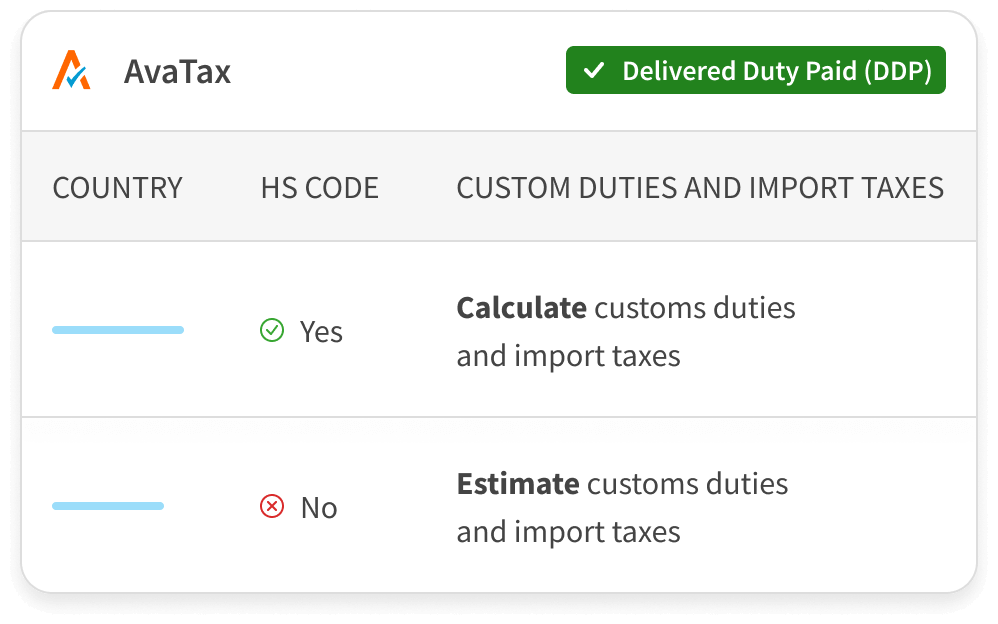
Calculate (for preclassified items) or estimate customs duties and import taxes in your online shopping cart.
Video: Avalara AvaTax calculates sales and use tax, VAT, GST, and customs duties and import taxes.
Streamline global transactions for your business and your customers
Provide more accurate landed costs
Use Avalara Tariff Code Classification for more accurate HS-6 or HS-10 classifications.
Leverage Avalara’s library of HS classifications by providing basic product information to generate a list of probable HS codes for real-time estimation.
Provide more accurate landed costs
Use Avalara Tariff Code Classification for more accurate HS-6 or HS-10 classifications.
Leverage Avalara’s library of HS classifications by providing basic product information to generate a list of probable HS codes for real-time estimation.
Deliver a superior customer experience
Create a transparent, frictionless online purchasing experience for international customers.
Provide a Delivered Duty Paid (DDP) buyer experience to reduce risk of cart abandonment.
Reduce the risk of undercharging or overcharging tax due to incorrect classification.
Deliver a superior customer experience
Create a transparent, frictionless online purchasing experience for international customers.
Provide a Delivered Duty Paid (DDP) buyer experience to reduce risk of cart abandonment.
Reduce the risk of undercharging or overcharging tax due to incorrect classification.
Scale your international growth
Simplify the complexities of cross-border sales.
Lean on our team of experts for ongoing support as your business expands.
Cut costs and increase accuracy with a flexible solution.
Scale your international growth
Simplify the complexities of cross-border sales.
Lean on our team of experts for ongoing support as your business expands.
Cut costs and increase accuracy with a flexible solution.
INTEGRATIONS
Avalara powers cross-border compliance for Shopify Markets and eBay International Shipping
“Automating sales tax was an absolute necessity for us, as it reduces the burden and strain on manual processes and our internal teams. Sales tax automation gives us peace of mind and the confidence to expand into new geographical areas.”
Model Context Protocol (MCP) servers connect Avalara AvaTax Cross-Border APIs to AI agents and partner platforms. This enables compliance tasks like customs duty and import tax calculation to run automatically inside ERPs, marketplaces, and supply chain systems. The result is faster onboarding, fewer errors, and smoother global trade operations.
A customs duty is the indirect tax levied on the import or export of goods in a cross-border transaction. Customs duties are currently limited to physical goods.
Import taxes are consumption taxes established by governments. They’re typically imposed as a percentage of the selling price (plus any customs duties) and they’re imposed on both imports and intra-country sales. VAT and GST are the most common forms of import taxes.
For real-time calculation of customs duties and import taxes, yes. HS codes, HTS codes, and tariff codes are tied to a country’s specific duty rate for the specific item. Having accurate HS codes is the first step to calculating cross-border taxes.
If you don’t have an HS code, you can still estimate customs duties and import taxes at checkout with minimal input data — don’t miss a sale when you use Avalara Cross-Border Estimated. This feature only applies to new transactions; any backdated transactions will need an accurate HS-10 code to produce a calculation.
Harmonized System (HS) codes are internationally standardized 6-digit codes that denote the product category and are used to classify traded goods. Ten-digit codes, which include the HS code as the first six digits, are used to determine import duties and regulations. These codes are referred to as Harmonized Tariff Schedule (HTS) codes by the U.S., TARIC codes in the EU, and may have different names in other countries and regions. The 10-digit codes are country-specific, meaning one item will have a unique code for each country. Schedule B codes are also U.S.-specific 10-digit codes used to classify exported goods, maintained by the U.S. Census Bureau . Tariff codes generally refer to the aforementioned codes used to impose duties on imports, vary by country, and are often based on the HS system.
Harmonized System (HS) codes — 6-digit internationally standardized codes to classify traded goods
Harmonized Tariff Schedule (HTS) codes and TARIC codes — 10-digit country-specific codes used to determine import duties and regulations
Schedule B codes — 10-digit country-specific codes used by the U.S. to classify exported goods
Tariff codes — the general term to refer to the codes listed above
Delivered Duty Paid (DDP) is a shipping model in which the seller takes responsibility for paying duties and taxes. For cross-border transactions sold under this model, the seller typically collects duties and taxes upfront as part of the online checkout experience. This is how customers expect to shop online.
Delivered at Place (DAP) is a shipping model in which the buyer takes responsibility for paying duties and taxes. For cross-border transactions sold under this model, the buyer typically pays duties and taxes upon receipt of the goods. This can lead to unwanted surprises and even rejected orders. Under this model, the seller is only responsible for the physical delivery of the goods.
A de minimis threshold is the valuation ceiling for goods below which no duty or tax is charged and clearance procedures, including data requirements, are minimal. De minimis thresholds for customs duties may be different than the threshold for import taxes for the same item. There are many factors that go into whether a shipment would be free from duty and/or taxes, and de minimis thresholds can be updated frequently. Assigning accurate tariff codes is the first step to prepare for these changes since a change in a de minimis threshold does not equal a change in tariff code.
Calculating customs duties and import taxes in real time at checkout helps reduce the risk of abandoned carts, products stuck in customs, and a bad buyer experience. By providing your customers with a more accurate landed cost, you’re providing them with a seamless online buying experience consistent with shopping domestically.