Desktop screen showing an upward growth chart with the Avalara logo and orange checkmark, on a navy circuit-board background.

How the race to deploy AI agents is outrunning finance governance

Agentic AI survey with Censuswide

Finance leaders are moving quickly to put AI agents to work. Pressure is rising, use cases are expanding, and adoption is picking up across core financial workflows.

Avalara’s new report, Agents of Change: How the Race to Deploy AI Agents is Outrunning Finance Governance, takes a closer look at that shift. Based on a Censuswide survey of more than 1,500 CFOs and senior finance leaders across the U.S., U.K., India, and Australia, the research shows a market leaning into agentic AI while still working through the rules, ownership, and proof points needed to use it with confidence.

Speed is setting the pace

Finance teams are no longer treating AI agents as a future concept. The leaders surveyed work at organizations that have deployed, piloted, or evaluated AI agents within financial processes in the past year. Across tax, compliance, accounts payable, invoicing, and financial close processes, they’re already testing where these systems can save time, reduce manual work, and improve execution.

The urgency behind that shift is hard to miss.

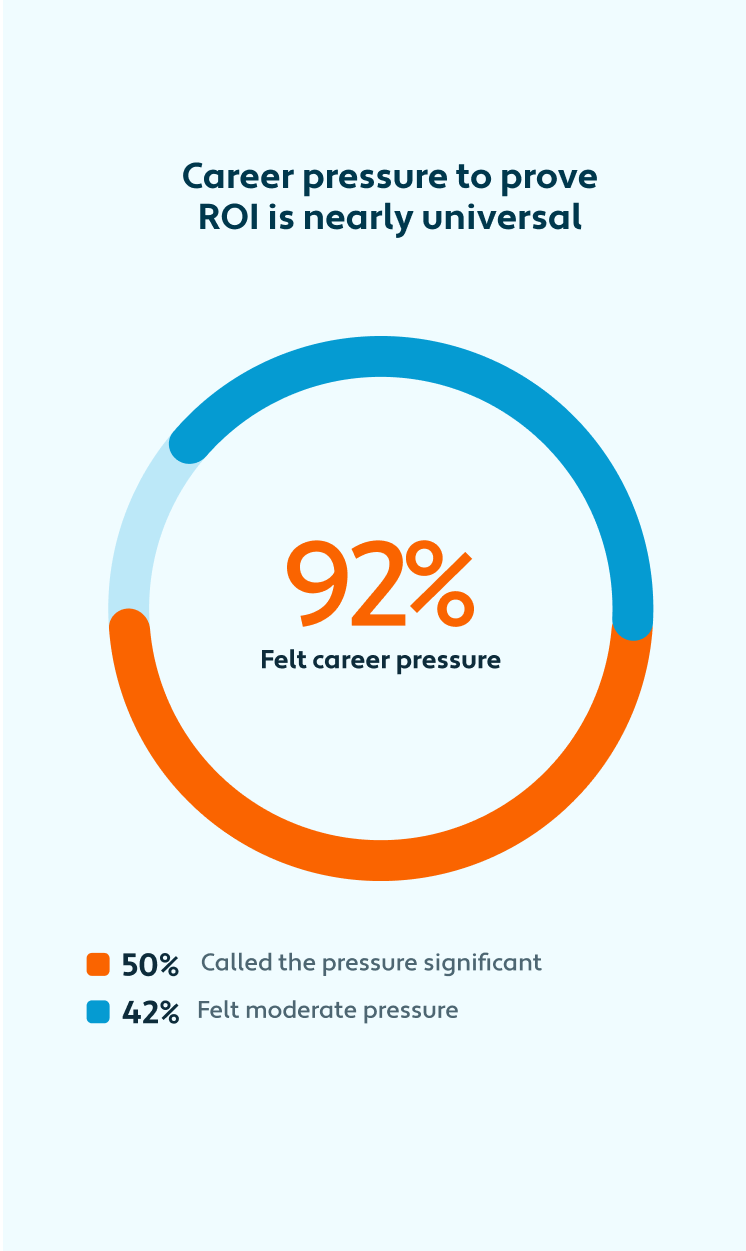
  • 92% of finance leaders said they feel personal career pressure to prove their AI agent investments are delivering against business objectives.
  • 71% said that pressure is entirely or mostly about the speed of agentic AI deployment.
  • Just 7% said governance is being prioritized first.

Career pressure to prove ROI from AI agents is nearly universal among surveyed finance leaders.

Figure 1: Career pressure to prove AI agent ROI is nearly universal among finance leaders.

For many finance leaders, the real question is how fast AI agents can be deployed, and whether governance can keep up.

ROI is starting to show up

The report doesn’t suggest that organizations are rushing into agentic AI without seeing value. In fact, most respondents said they’re already seeing at least some measurable ROI.

Still, the picture is far from settled. While 88% reported some measurable return, half (43% in the U.S.) said those gains have been limited so far. That suggests many organizations are still proving value, not yet scaling from a position of certainty.

The real gap is governance and trust

This is where the challenge becomes clearer.

The survey shows that many finance teams are adopting AI agents faster than they’re building the internal structures required to manage them well. For a function accountable to auditors, regulators, and internal stakeholders, that gap matters.

A few findings make the point:

  • 76% said they lack dedicated in-house expertise to understand how their AI agents work.
  • 30% said they haven’t updated their internal control framework in the past year to account for AI-driven actions.
  • 46% (and just 38% in the U.S.) said their AI incident response plans are untested or still in development.

Survey responses show that responsibility for AI-agent failure is still fragmented across vendors, teams, individuals, and executives.

Figure 2: Responsibility for AI-agent failure remains fragmented across vendors, teams, and executives.

At its core, there is a gap between adoption and operational readiness.

What finance leaders need before they trust AI agents at scale

The report also shows that finance leaders are being specific about what they need from vendors and platforms. They are looking for AI agents that can work within existing controls, use verified data, and hold up in regulated financial environments where accuracy, oversight, and auditability matter.

What finance leaders want:

  • Agents that can work within the rules, permissions, and controls of existing systems
  • Outputs grounded in verified tax, compliance, or financial data
  • Evidence that those outputs are tested against known compliance requirements
  • Clear audit trails showing what the agent did and why

That changes the conversation. In finance, trust depends on governed execution, and on whether an outcome can be traced, explained, and defended when the stakes are high.

How Avalara fits into the path forward

For organizations already feeling the strain between deployment speed and governance readiness, the path forward is becoming clearer. AI agents need to work within existing controls, rely on verified domain-specific data, keep humans involved at the moments that matter, and produce outcomes that are audit-defensible.

That’s where Avalara’s approach becomes relevant. The focus is on building agentic AI for the precision and accountability that tax and compliance demand, across the full compliance life cycle rather than in isolated tasks. The goal is to help finance teams move faster with systems they can explain, oversee, and trust, with governance and auditability built into workflow execution from the start.

Get the full insights

The pressure to deploy AI agents is real. So is the governance gap forming around them.

Download the full Agents of Change report for the complete findings, including regional differences, governance challenges, accountability concerns, and the proof points finance leaders say matter most before AI agents can be trusted at scale.

Recent posts
More control over compliance costs and workflows: Avalara product updates for July
More property tax relief, more rules: Navigating enterprise compliance
From FIRE to IRIS and beyond: Preparing for 2026 reporting changes to 1099 compliance
ATC 2026 Midyear Update

The Avalara Tax Changes midyear update is here

Trusted by professionals, this valuable resource simplifies complex
topics with clarity and insight.

Get the latest update

Stay up to date

Sign up for our free newsletter and stay up to date with the latest tax news.