Traditional business-to-business (B2B) and business-to-consumer (B2C) companies are discovering it pays to sell online. During the last year, extensive restrictions on in-person meetings and commerce forced many B2C and B2B companies, including manufacturers, to embrace ecommerce and grow direct-to-consumer sales. While the success of these efforts underscores the need for them, as the adage says, success comes at a price: An increase in B2B and B2C online sales can trigger new sales and use tax obligations.
The impact of the coronavirus pandemic on business and consumer habits was unexpected and immediate. Virtually overnight, businesses had to restrict or shut down in-person experiences and the internet became the only way to engage colleagues and customers. Ecommerce kept numerous businesses afloat during that difficult time, and many businesses and consumers will continue to rely on it even as eased restrictions and a hunger for face-to-face experiences encourage a return to “beforetime” habits.
To better understand how this shift in consumer habits has affected businesses, Salesforce surveyed close to 1,400 commerce leaders in August 2020 and analyzed the shopping behavior of more than 1 billion customers worldwide. The survey encompasses data from B2B and B2C organizations across 11 industries,* from advertising to travel.
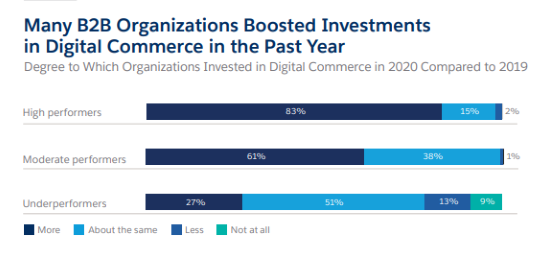
The report classifies respondents by their digital commerce performance. About 35% of those surveyed are high performers, meaning they consider themselves to be “extremely successful” in digital commerce. Slightly more than half — 55% — believe their organization is “moderately successful” in digital commerce (moderate performers), while 10% are “underperformers” in the digital commerce space.
The results of the first State of Commerce report reveal how much companies relied on ecommerce last year. And lessons learned during the height of the pandemic won’t soon be forgotten: 66% of high-performing companies surveyed are augmenting or replacing in-store experiences with digital ones, and 56% of organizations expect the majority of their revenue over the next three years to come from digital channels.
For many industries, placing such an emphasis on the internet and ecommerce is new; only about 11% of all U.S. retail sales took place online in 2019. But brick-and-mortar sales dropped an estimated 14% in 2020, while ecommerce revenue increased 75% year over year during the second quarter of 2020 alone. Few companies, if any, can afford to disregard the opportunities afforded by the internet.