

What is the pink tax?
Back in 2016, a New York City pharmacy put up signs announcing that all female customers could shop tax free, while all male customers were subject to a 7% man tax. It was done to raise awareness about gender pricing discrimination, also known as the pink tax.
Key takeaways
The pink tax describes gender-based price discrimination and other forms of financial inequality. It can also refer to sales taxes on products that are designed for and marketed to women.
Some jurisdictions have outlawed pink taxes. They’re illegal in California, New York, and at least one county in Florida.
States are getting rid of sales tax pink taxes. Many states now provide a sales and use tax exemption for period products.
What is the pink tax?
Most broadly, the pink tax describes gender inequality in various forms, including the gender pay gap.
More specifically, the pink tax refers to gender-based price discrimination: the fact that some products and services designed for women or girls may cost more than similar products and services designed for men or boys.
Pink tax can also describe a sales tax on period products, like tampons.
Is the pink tax a real tax?
The pink tax isn’t a traditional “tax,” but a number of studies have concluded the pink tax is real.
“Examples of gender-based price disparities for goods and services have been documented throughout the economy,” noted a December 2016 report by the Joint Economic Committee of the United States Congress. “This phenomenon may not constitute intentional gender discrimination. Yet the frequency with which female consumers find themselves paying higher prices for gender-specific goods and services effectively becomes a tax on being a woman.”
Evidence the pink tax exists
A 1992 investigation of price discrimination against women conducted by the New York City Department of Consumer Affairs (DCA) concluded that women paid more than men at dry cleaners, hair salons, launderers, and used car dealers. Then, in 1994, California’s Assembly Office of Research found that 64% of stores in five major cities charged more to launder a woman’s white cotton shirt than a man’s white cotton shirt, and that women in California paid on average $5 more for a haircut than men.
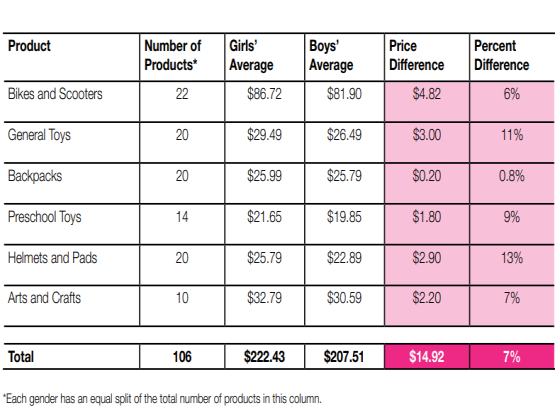
Roughly two decades later, in 2011, researchers at the University of Central Florida reported that 85 out of 100 surveyed hair salons charged an average of 54% more for a basic women’s haircut than a basic men’s haircut.
And in 2015, after reviewing nearly 400 pairs of products sold by New York City retailers, the New York City DCA concluded women’s products “were priced higher” than similar products for men. DCA found that 42% of women’s products were priced higher than similar men’s products. By contrast, men’s products had a higher price tag 18% of the time.
Evidence the pink tax may not exist
In 2018, the U.S. Government Accountability Office (GAO) examined prices for 10 categories of personal care products geared to women and men. After controlling for size and other factors that could lead to price discrepancies, GAO found women paid more than men for the following five products:
- Body deodorant
- Body spray
- Designer perfume
- Shaving cream
- Underarm deodorant
However, the following products for men cost more than similar products for women:
- Nondisposable razors
- Shaving gel
There was no discernible gendered price for the following:
- Disposable razors
- Disposable razor blades
- Mass-market perfumes
Ultimately, GAO couldn’t definitively conclude there was a pink tax — or that there wasn’t. “GAO found that the target gender for a product is a significant factor contributing to price differences identified, but GAO did not have sufficient information to determine the extent to which these gender-related price differences were due to gender bias as opposed to other factors, such as different advertising costs.”
Is a tampon tax a pink tax?
“Pink tax” is sometimes used to describe “tampon tax,” which is actually a sales and use tax on tampons and other period products. According to the Congressional Joint Economic Committee, the sales tax on feminine hygiene products is an example of “gender-based pricing.”
Though a number of states now exempt tampons and other period products, as of May 28, 2026, sales tax applies to menstrual products in 18 states: Arizona, Arkansas, Georgia, Hawaii, Idaho, Indiana, Kansas, Kentucky, Mississippi, North Carolina, North Dakota, Oklahoma, South Dakota, Tennessee, Utah, West Virginia, Wisconsin, and Wyoming.
Some businesses are taking a stand against these pink taxes. In October 2022, CVS started paying the applicable sales tax on period products in 12 states. It continues to pay sales tax on period products in Arkansas, Georgia, Hawaii, Louisiana, Missouri, Tennessee, Utah, Virginia, Wisconsin, and West Virginia. (Period products are now exempt in the other two states: South Carolina and Texas.) Some states don’t allow businesses to absorb sales tax.
CVS also reduced the price of CVS-brand period products by 25% in all U.S. stores.
Is import tax the true pink tax?
If there is a true tax on gendered items, it’s likely import tax (aka, customs duty or tariffs). In 2015, the Mosbacher Institute for Trade, Economics, and Public Policy at Texas A&M University found that clothing companies pay higher import taxes on certain women’s apparel than on similar men’s apparel.
Rates aren’t always based on gender, but gender is one way for governments and customs officials to distinguish the millions of products that cross international borders every day. In fact, the Mosbacher Institute determined that 86% of U.S. apparel imports and 79% of U.S. footwear imports in 2014 were gender-classified by the United States International Trade Commission. And gender-based discrepancies on import taxes persist today.
For example, women’s or girls’ shirts knitted or crocheted from man-made fibers and containing 23% or more of wool or fine animal hair (HTS 61062010) are generally subject to a 14.9% import tax. By contrast, men’s or boys’ shirts made in the same way of the same materials (HTS 61052010) are generally subject to a 13.6% import tax.
It’s fun to search Harmonized Tariff Schedule for duty rates. Learn more about HTS codes.
The Mosbacher Institute would like to see Congress address the gender import tax disparity, perhaps by banning “tariff differentials on products that are gender-classified, but otherwise identical.”
Is the pink tax legal?
There’s currently no federal law prohibiting gender-based price discrimination. The 2021 Pink Tax Repeal Act sought to outlaw gender-based taxes, but the bill garnered little attention and wasn’t enacted. A 2025 version of the Pink Tax Repeal Act has also made little progress.
However, at least two states and one jurisdiction have prohibited so-called pink taxes — and their counterpart, blue taxes.
California bans gender-based price discrimination
California’s Gender Tax Repeal Act of 1995 prohibits businesses of any kind from discriminating, with respect to the price charged for services of similar or like kind, against a person because of the person’s gender. However, it allows businesses to set different prices “based specifically upon the amount of time, difficulty, or cost of providing the services.”
Because it applied to services but not to products marketed to women, the 1995 law left the gender-based pricing ban undone. In 2022, the California Assembly rectified that oversight with the enactment of AB-1287. As of January 1, 2023, California businesses are prohibited from charging a different price for any two goods that are substantially similar, “if those goods are priced differently based on the gender of the individuals for whom the goods are marketed and intended.”
Like its predecessor, the 2022 California law doesn’t prohibit price differences based specifically upon:
- The amount of time it took to manufacture those goods.
- The cost incurred in manufacturing those goods.
- The difficulty in manufacturing those goods.
- The labor used in manufacturing those goods.
- The materials used in manufacturing those goods.
- Any other gender-neutral reason for charging a different price for those goods.
New York state bans gender-based price discrimination
New York City prohibited retail establishments from discriminatory pricing based on gender in 1998. It also granted the city’s Department of Consumer Affairs (DCA) the authority to issue fines to businesses found violating the law. You can still file a complaint about NYC retail service establishments that charge men and women different prices for the same service.
New York state officially banned gender-based pricing for substantially similar products or services effective September 30, 2020. As in California, New York state doesn’t prohibit price differences in goods or services that are based on the amount of time or difficulty it took to manufacture the goods or perform the services, the cost incurred in manufacturing the goods or performing the services, and similar considerations.
Miami-Dade County bans gender-based price discrimination
Though price discrepancies based solely on gender haven’t been outlawed by the state of Florida, they’re illegal in Florida’s Miami-Dade County. The county’s gender-based price discrimination ordinance applies to both goods and services and to sales by individuals as well as businesses.
As seems to be the norm in such cases, price disparities for comparable products are legal under certain circumstances, such as if products for one gender cost more to produce or obtain than products for another gender.
What’s the future of the pink tax?
Your guess is as good as ours.
Congress could ban gender-based price discrepancies, as could more state and local governments. Yet bans may not be effective if it costs businesses more to manufacture or import certain gendered products. Indeed, the pink tax is already outlawed in some parts of this country, and it may still exist.
And the pink tax could evolve to become nonbinary. As GAO discovered, some products geared toward men cost more than comparable products geared toward women. Furthermore, a growing number of consumers that purchase products subject to the so-called pink tax may not identify as female.
Pink tax FAQ
Which states have banned pink taxes?
California and New York have laws prohibiting gender-based price discrepancies.
Will any states ban the pink tax in 2026?
While numerous states introduced bills to outlaw pink taxes in 2024, states seem to have a different focus now. For example, legislation under consideration in Louisiana would prohibit employment discrimination based on gender identity or sexual orientation, and a bill in New Hampshire seeks to remove all references to gender identity.
Which states could eliminate sales tax on period products?
As of May 28, 2026, legislation to exempt period products is under consideration in Arizona, Georgia, Kentucky, North Carolina, Tennessee, Virginia, and West Virginia. Hawaii, North Carolina, South Carolina, Texas, and Wisconsin.
Avalara AvaTax ensures each transaction is taxed based on jurisdiction, product type, exemption rules, and more. Learn about automating tax calcuation with AvaTax.
This blog post has been updated.



The Avalara Tax Changes midyear update is here
Trusted by professionals, this valuable resource simplifies complex
topics with clarity and insight.
Stay up to date
Sign up for our free newsletter and stay up to date with the latest tax news.