States will play a long game for revenue and strive to create more equitable tax policies.
A year ago, it looked like the world would end. It didn’t. State and local governments are surprisingly flush after receiving a combined $350 billion from the American Rescue Plan Act (ARPA), with states getting $195.3 billion of the funds. Since “states have only seen revenue declines of $2 billion” according to the Tax Foundation, the state aid amounts to “116 times overall losses.”
With fuller pockets than anticipated, many state policymakers don’t need to base their decisions on immediate fiscal needs. Instead, they’ll play a long game, developing tax policies in response to technological disruptions and evolving consumer habits.
Scott thinks they’ll also reflect the zeitgeist and focus on making tax laws more equitable. Equity-based reform is driven by changes in consumer behavior and technological disruptions. Examples include taxing online sales, taxing vaping products and marijuana, and taxing digital goods and services.
Equity-based tax reform: Taxing online sales
Taxing remote sales is a perfect example of both long-term and equity-based reform. States started fighting for the right to tax businesses with no physical presence in the state decades before the birth of ecommerce, because not taxing remote sales put in-state businesses at a competitive disadvantage to out-of-state retailers making tax-free sales via catalog, mail, and phone. Ecommerce then disrupted retail and made the need to tax remote sales stronger.
The playing field for in-state and out-of-state retailers is now more level thanks to the Wayfair decision and subsequent economic nexus and marketplace facilitator laws. Yet the level playing field can be jeopardized by noncompliance: If remote sellers aren’t collecting sales tax as they should, out-of-state sellers continue to get preferential tax treatment.
So, states need to be able to identify out-of-state online sellers who should be registered but aren’t.
Equity-based tax reform: Taxing new types of sales
Equity-based reform can also drive states to broaden tax to new products and services. One way to make tax policies more fair is to make them less regressive. The Tax Foundation has long argued sales tax would be more equitable and neutral if states broadened the tax base and lowered the tax rate.
Thus, six of the states surveyed expressed an interest in legalizing — and taxing — recreational marijuana. Scott says taxing marijuana is so lucrative it may have sucked the air out of other so-called “sin” taxes, but at least one state is looking to amend its tax on sugary beverages, and some states are interested in taxing or increasing the rate on electronic cigarettes and other vaping products. At the federal level, the Prevent All Cigarette Trafficking (PACT) Act was recently expanded to include all electronic nicotine delivery systems.
Indeed, marijuana and vaping products are a perfect example of how states need to adapt their laws and tax policies to changing consumer habits. They need to ensure new types of sales are regulated and taxed so they’re not receiving preferential treatment, and so revenue streams will remain intact.
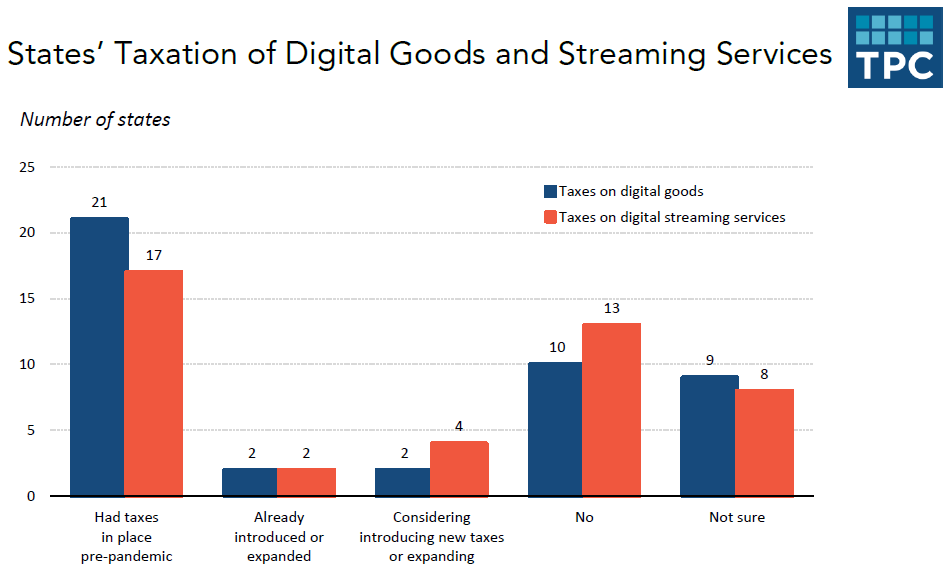
Thus, four states said they plan to tax new services, primarily digital streaming and subscription services. States that taxed these products and services benefited during the pandemic, but the report notes that “taxing the digital economy can be challenging and have unintended consequences.” One need look no further than Maryland's contentious digital advertising tax to understand why states want to further study this issue.