
Classify product catalogs with AI, at scale

Avalara Intelligent Tax Classification pairs AI with human review to help teams classify SKUs more accurately and with audit-ready records.

AI-powered tax code classification, backed by trusted tax content

3B+

items used to train AI engine

8,000+

brands represented in product data

60,000+

regulatory sources

20+

years of trusted experience

AI

AI recommends, you decide

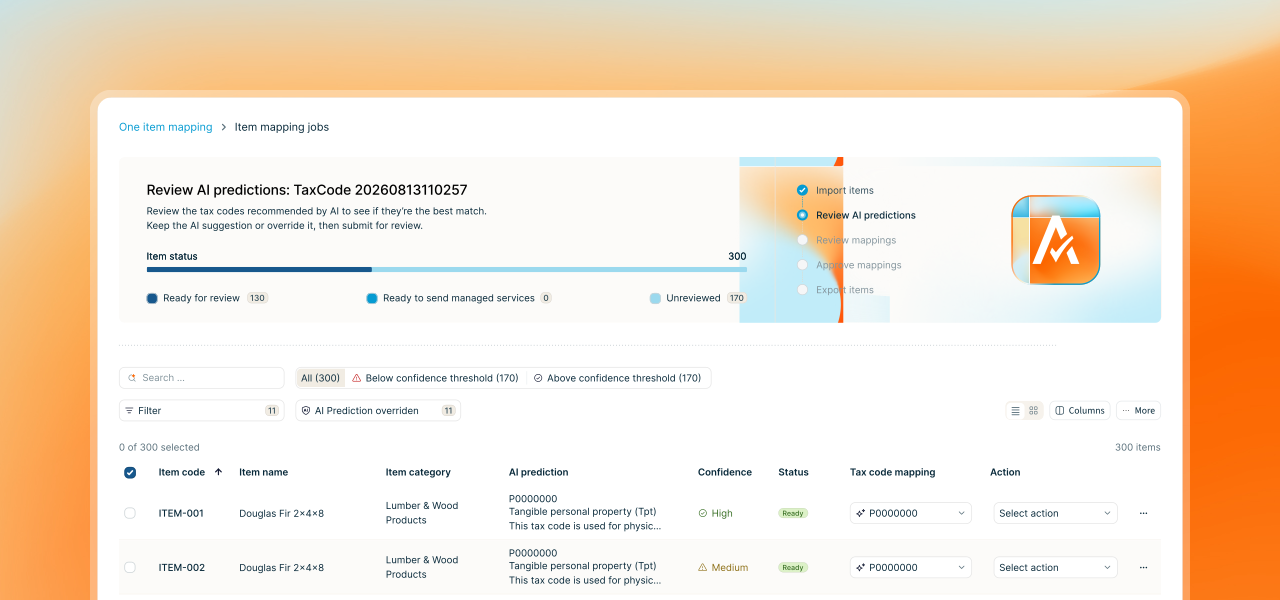
Every SKU gets a classification recommendation, confidence score, and plain-language explanation. Accept high-confidence results in bulk, and route edge cases to your team or Avalara experts.

Scale

Built to scale, built to last

Whether you’re classifying 10,000 SKUs or 10 million, Avalara Intelligent Tax Classification helps maintain accuracy through catalog growth, new-state expansion, or the inherited complexity of an acquired catalog.

Audit

Audit-ready records for every decision

Every action — whether AI-generated, adjusted, or expert-reviewed — is time-stamped and stored, giving teams a clear record when auditors ask why a product was coded a certain way.

Rules

Flexible workflows for every team

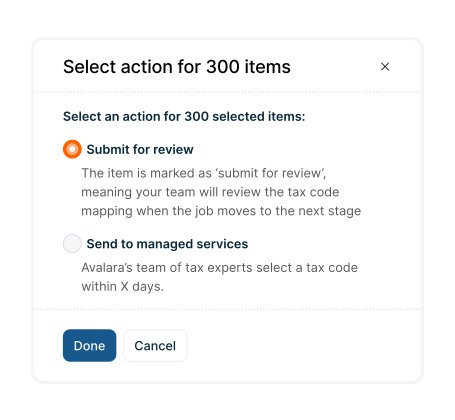
Choose self-service, an automated API, managed services, or a mix of delivery modes as your needs change. Role-based workflows help ensure the right reviewers approve tax code decisions before they move downstream.

Avalara Intelligent Tax Classification uses AI to guide SKU classification from submission to export

See how trusted content, AI recommendations, and human review controls streamline tax code classification from start to finish.

Intelligent Tax Classification

AI-assisted classification, governed by your team

Avalara Intelligent Tax Classification applies AI to one of the most manual parts of tax compliance: assigning the right tax code to every product. The platform recommends codes, explains why each one was suggested, and gives teams the control to accept, adjust, approve, or escalate.

HOW IT WORKS

From catalog upload to approved classifications in four steps

Submit

Import your product catalog

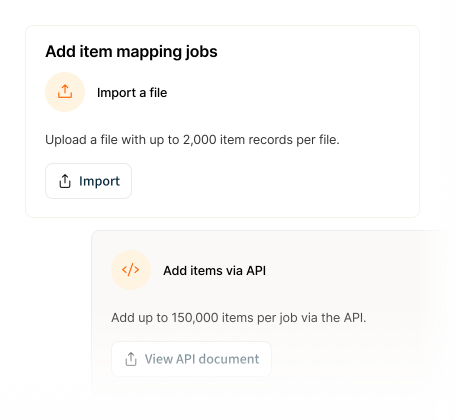
Upload your catalog through the Self-Service Portal using CSV or Excel, or submit high-volume jobs through the fully automated API. Catalogs of any size can be submitted as a single job.

  • Bulk import through CSV, Excel, or API 
  • No per-item research cycle
Review

Review AI recommendations with context

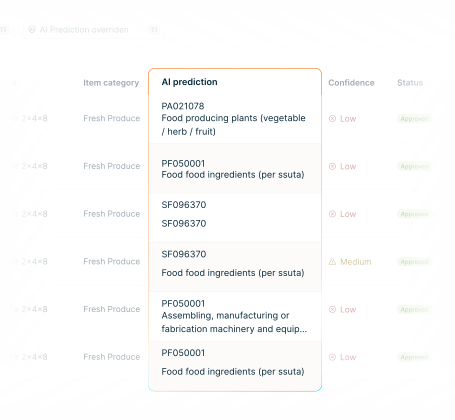
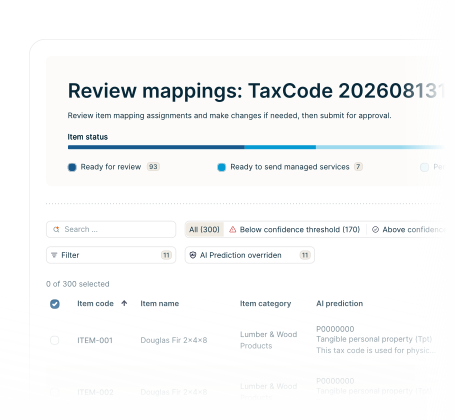
AI analyzes product descriptions and attributes, then returns a recommended code along with a confidence score. Items with a high-confidence score can be accepted in bulk; others are flagged for review.

  • Recommended code for each SKU 
  • Confidence score for each code 
  • Bulk acceptance for high-confidence results
Approve

Route decisions to the right reviewer

Role-based workflows route flagged items to the right reviewer. Every action (accept, adjust, or reject) is logged with a time stamp and user ID.

  • Role-based approval workflows that fit your team structure
  • Escalation to Avalara experts without leaving the platform 
  • One record whether the code came from AI, your team, or Avalara experts
Export

Export finalized classifications to your business systems

Finalized classifications flow to your ERP, POS system, commerce platform, or downstream Avalara solutions, with documentation that supports audit review.

  • Export classifications through file output or API 
  • Use classifications in Avalara or non-Avalara systems 
  • Preserve the decision record for audit review  

AI-powered tax classification you can trust

Explore how AI-powered tax classification turns spreadsheets and guesswork into one governed workflow

Built for large catalogs and changing classification needs

image

Tax and operations leaders

Avalara Intelligent Tax Classification gives tax teams one governed workflow for product classification. Review AI recommendations, route exceptions, and keep records without relying on disconnected spreadsheets, portals, or handoffs.

image

Businesses with frequent catalog updates

When catalog size makes item-by-item research hard to sustain, Avalara Intelligent Tax Classification supports high-volume classification jobs. Import 10,000 to 1 million+ SKUs and use confidence scores to prioritize what needs review. 

image

Teams expanding into new states or marketplaces

New SKUs, product changes, and catalog growth can create classification gaps. Avalara Intelligent Tax Classification helps teams keep classifications moving as catalogs change, with review workflows and exportable records built in.

FAQ

Intelligent Tax Classification is a unified, AI-powered platform for classifying product catalogs to tax and compliance codes. It brings spreadsheets, portals, and manual handoffs into one governed workflow.

No. Intelligent Tax Classification is available standalone so teams can classify product catalogs and export results to Avalara or non-Avalara systems.

Intelligent Tax Classification supports Avalara tax codes across all 50 U.S. states at launch. HS codes, UNSPSC, and ECCN are on the road map, so teams can expand into additional classification needs from the same platform later.

The Intelligent Tax Classification AI engine is trained on 3 billion+ items across 8,000+ brands and grounded in the same tax data that powers the Avalara tax engine. Each recommendation includes a confidence score and plain-language explanation, giving teams the context to review, accept, adjust, or escalate.

Yes. Intelligent Tax Classification works with systems that can consume a REST API or standard file export, including SAP, Oracle, NetSuite, Microsoft Dynamics 365, Shopify, BigCommerce, and QuickBooks. Classifications are portable to downstream systems, including non-Avalara tax engines.

You can route some or all of your catalog to Avalara managed services experts from the same platform. Use self-service, an automated API, managed services, or a mix of delivery modes as your needs change.

Classify every SKU with confidence

See how Avalara Intelligent Tax Classification helps teams accelerate SKU classification from product data to approved codes.