
E-invoicing

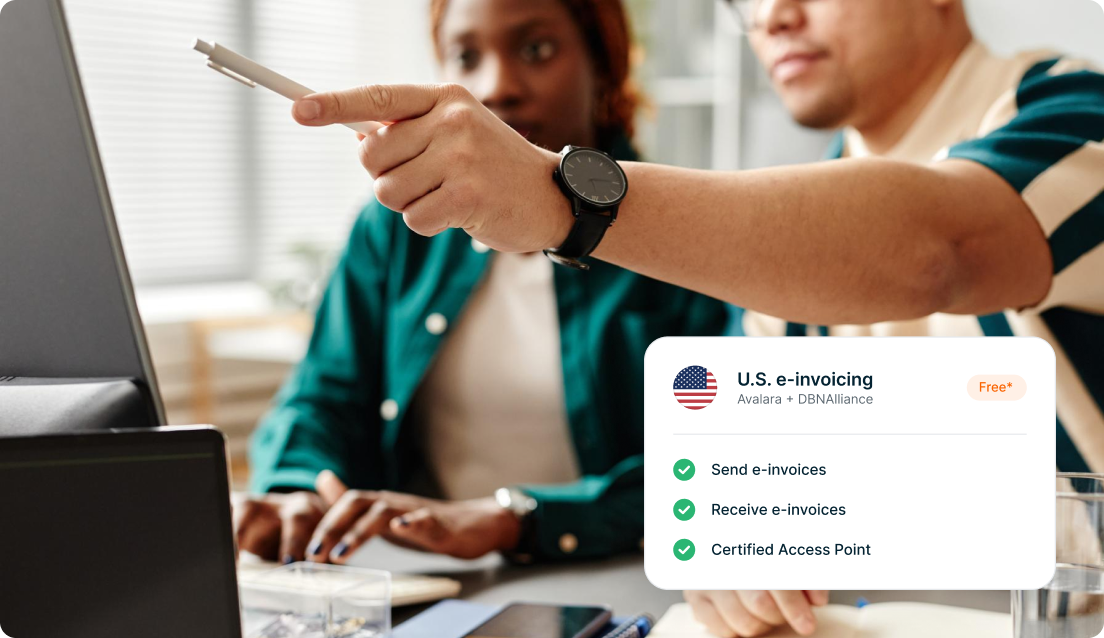
Free* U.S. e-invoicing
through Avalara and
DBNAlliance

Send and receive structured B2B e-invoices at no cost while building a scalable model for U.S. and global compliance.
*Subject to terms and conditions

U.S E-INVOICING TIMELINE

Key developments

  • 2023: The Business Payments Coalition pilot helps establish the DBNAlliance exchange framework
  • 2024: Avalara sends the first live invoice through the DBNAlliance B2B Digital Highway
  • 2025: Avalara offers free domestic U.S. e-invoicing through its certified DBNAlliance Access Point
  • Ongoing: U.S. B2B adoption remains market-driven as global e-invoicing mandates continue to expand

E-invoicing in the United States with Avalara and DBNAlliance

Abstract seamless background with a subtle repeating wave pattern in pale sand and cream tones.

Enterprise risk indicators

Signs that your current invoicing infrastructure is at risk from evolving compliance mandates and costly system fragmentation.

  • Reliance on PDF, paper, email, or portal-based invoice workflows
  • Costly point-to-point EDI connections and customer-specific formats
  • Fragmented AP and AR processes across business units
  • Limited structured invoice data validation
  • Manual exception handling and limited life-cycle visibility
  • U.S. systems and data models not aligned with global e-invoicing requirements
  • Global operations exposed to local reporting, signature, and archiving rules
  • Country-specific integrations that are difficult to scale or govern
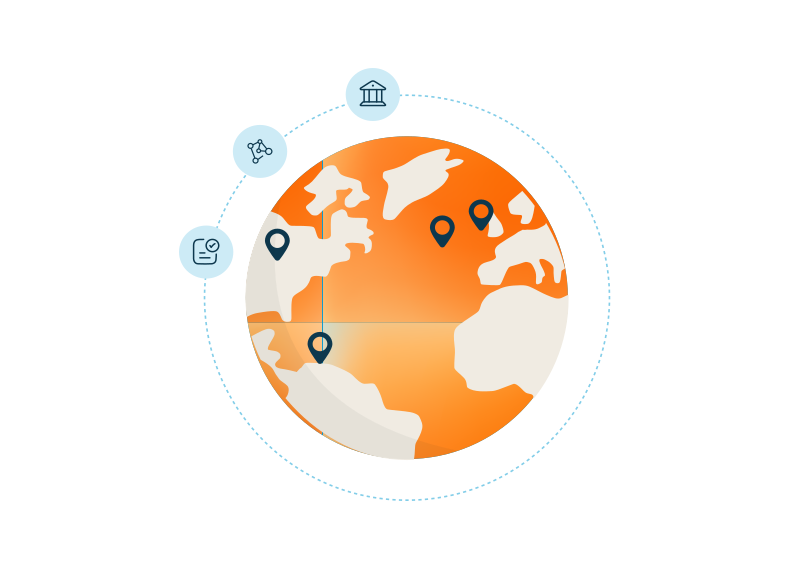
Orange globe with location pins and government building and document icons

Build a U.S. e-invoicing model that scales across countries

  • Foster cross-team alignment. Bring Tax, Finance, AP, AR, Procurement, and IT into a shared workstream to align on digital invoicing goals, system readiness, and global compliance obligations.
  • Assess U.S. invoice complexity. Identify where invoices are still exchanged through paper, PDF, email, EDI, procurement portals, AP networks, or customer-specific workflows.
  • Map current invoice flows. Document ERP systems, invoice routing, supplier and customer requirements, exception handling, payment dependencies, and reporting touchpoints.
  • Evaluate Avalara DBNAlliance eligibility. Determine whether your business can use Avalara’s certified DBNAlliance Access Point for eligible U.S. domestic e-invoices and credit notes.
  • Prepare ERP systems and data. Validate invoice data completeness, field mapping, tax logic, customer identifiers, supplier records, and integration requirements across systems.
  • Build for global scalability. Use one operational model to support U.S. digital exchange, global networks, and evolving country-specific mandate requirements.

Domestic adoption may be voluntary today, but global mandates are accelerating. A scalable model can support U.S. digital exchange and country-specific compliance without duplicating work.

The United States is part of a global shift

U.S. adoption is market-driven, but global mandates are not. Build one model for voluntary exchange and mandatory compliance.

Prepare for U.S. e-invoicing and every mandate that follows

Avalara E-Invoicing and Live Reporting’s certified DBNAlliance Access Point gives eligible U.S. businesses an alternative to exchanging invoices through PDF, email, EDI, customer portals, or proprietary networks. Instead, they can send and receive structured invoices through the DBNAlliance exchange framework, improving connectivity across trading partners.

Enterprises and multinationals increasingly need invoice workflows that support structured exchange, customer-specific requirements, AP automation, and cross-border mandates. Those mandates may involve different formats, APIs, endpoints, tax authority platforms, life-cycle statuses, digital signatures, QR codes, certification, and long-term archiving. A local or tactical approach may address one requirement but become difficult to manage as mandates multiply.

Avalara supports a more scalable approach through its Agentic Tax and Compliance™ platform — designed to automate complex tax and e-invoicing workflows across countries, systems, and changing regulatory requirements.

The goal: Build a scalable foundation for e-invoicing, then scale compliance globally as mandates compound and evolve.

Simplify e-invoicing with Avalara

ADDITIONAL RESOURCES

Learn how DBNAlliance works

Related Products

FAQ

There is no nationwide B2B e-invoicing mandate in the United States today. Unlike many countries with VAT-driven e-invoicing or live reporting mandates, the United States does not have a federal VAT system or a single national indirect tax authority to drive invoice reporting. Federal procurement is different. U.S. federal agencies are directed to manage invoices for federal procurements electronically, and vendors must have the option to submit invoices electronically.

The U.S. indirect tax system is highly decentralized. Sales tax is administered at the state and local level, not through a federal VAT or GST system. That makes a centralized, tax-driven e-invoicing mandate more difficult than in countries where one national tax authority can define invoice, clearance, and reporting requirements.

DBNAlliance is a nonprofit organization that oversees the U.S. open exchange framework for electronic business documents. The framework is designed to help businesses exchange structured invoices through service providers using common standards and policies.

Avalara’s certified DBNAlliance Access Point enables eligible U.S. businesses to send and receive structured domestic B2B e-invoices and credit notes through the DBNAlliance exchange framework.

DBNAlliance is not a tax authority clearance or reporting model. U.S. tax authorities do not receive, approve, or validate invoices through the network. However, tax-related data fields, including tax category and exemption codes, are part of the structured invoice approach and can help support automation, tax coding, and invoice processing.

No. The U.S. exchange framework uses a four-corner model similar to Peppol, but the United States is not adopting Peppol as its national network. DBNAlliance is focused on the U.S. and wider North American market. However, U.S. businesses can still connect to Peppol through a certified service provider such as Avalara for international procurement, cross-border sales, or trading partner requirements in Peppol markets.

DBNAlliance uses UBL 2.3 for invoices and credit notes. The network also uses AS/4 for secure exchange and relies on SML and SMP technologies to support participant discovery and routing.

Avalara’s public offer includes no document, connector, or transaction fees for eligible U.S. domestic B2B e-invoices and credit notes sent through Avalara’s DBNAlliance Access Point. Implementation support and enhanced services may involve additional costs. *Subject to terms and conditions

Avalara’s offer supports eligible U.S. domestic e-invoices and electronic credit notes, as well as cross-border e-invoices sent into the United States for U.S. legal entities. Other document types and international outbound e-invoicing may involve additional services or fees.

The free offer is limited to e-invoicing within the United States and cross-border e-invoices sent into the United States for U.S. legal entities. International outbound e-invoicing can be supported through Avalara E-Invoicing and Live Reporting but may involve additional transaction fees.

Yes. However, those workflows can create fragmentation, manual processing, duplicate integrations, and limited visibility. Structured e-invoicing can help reduce those inefficiencies and prepare the business for global mandate requirements.

U.S. e-invoicing adoption is moving through market infrastructure rather than a single federal mandate. Businesses that prepare early can reduce manual invoice handling, simplify trading partner exchange, improve data quality, and build a foundation for global e-invoicing compliance.

Yes. The DBNAlliance four-corner model is designed for interoperability. Businesses can choose their own access point provider and exchange invoices with trading partners using other providers connected to the network.

Yes. The United States has not adopted Peppol as its national e-invoicing network, but U.S. businesses can still connect to Peppol through a certified service provider like Avalara for international procurement, cross-border sales, or trading partner requirements in Peppol markets.

Schedule a readiness session

In a 45-minute working session, Avalara experts will help you assess eligibility, review your ERP environment, identify system and data gaps, and evaluate how DBNAlliance connectivity can support your U.S. and global e-invoicing readiness.