
E-invoicing

Peppol can help move invoices, but compliance takes more

Peppol helps businesses exchange e-invoices across systems and borders. But local mandates still define what compliance requires.

PEPPOL EXPLAINED

What is Peppol?

Peppol is a network that lets trading partners exchange electronic documents, including e-invoices, even when they use different systems or service providers. Buyers and suppliers connect through certified access points to help transmit documents securely.

How e-invoices move across the Peppol network

Why businesses use Peppol for e-invoice exchange

Interoperability across systems

Peppol helps businesses exchange electronic documents across different platforms, providers, and trading partner systems.

Support for public procurement

Governments use Peppol to modernise procurement, standardise supplier exchange, and reduce manual invoice handling.

Fewer custom connections

Businesses can use Peppol as a common network model for every trading partner, rather than building separate point-to-point integrations for each one. 

Easier supplier participation

A shared exchange network can make it easier for suppliers, buyers, and providers to participate in digital invoicing.

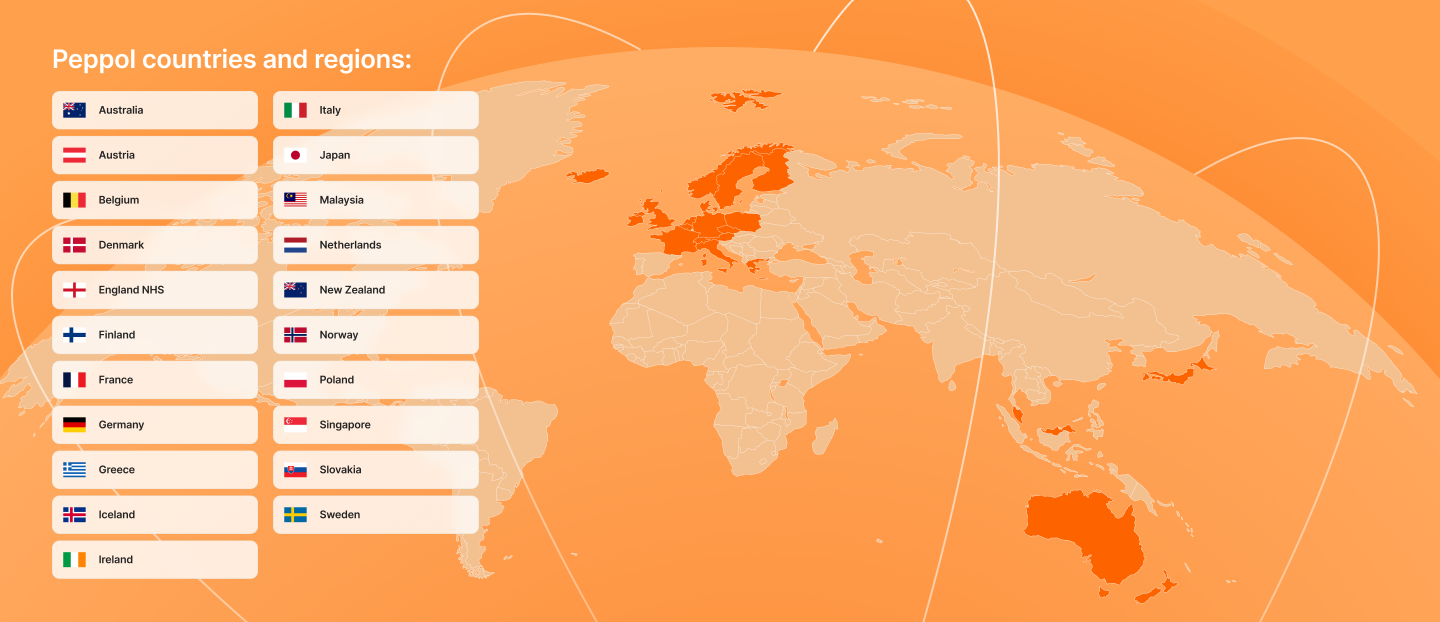
Which countries use Peppol?

  • Australia
 
  • Austria
 
  • Belgium
 
  • Denmark
 
  • England NHS
 
  • Finland
  • France
 
  • Germany
 
  • Greece
 
  • Iceland
 
  • Ireland
  • Italy
 
  • Japan
 
  • Malaysia
 
  • Netherlands
 
  • New Zealand
  • Norway
 
  • Poland
 
  • Singapore
 
  • Slovakia
 
  • Sweden

Peppol supports exchange. It does not solve every mandate.

Peppol is sometimes viewed as a shortcut to e-invoicing compliance, but it is only one part of the requirement. Businesses must still solve for local rules across invoice data, reporting timelines, validation, storage, and transaction scope.

What Peppol provides

What compliance may still require

A network for exchanging electronic documents

Country-specific mandate analysis

Standardised exchange between access points

Local invoice formats, fields, and tax rules

Interoperability between trading partners

Reporting, clearance, or validation workflows

Structured e-invoice transmission

ERP, Tax, Finance, and archive integration

A scalable connection model

Monitoring regulatory changes over time

Peppol with Avalara

Connect to Peppol without losing sight of compliance

Peppol can support invoice exchange, but compliance depends on the rules in each market where you operate. Avalara can help you assess mandate requirements and build a scalable approach across Tax, Finance, and IT.

Avalara helps your business:

  • Connect to Peppol and other e-invoicing networks 
  • Address country-specific requirements beyond document exchange
  • Manage e-invoicing and live reporting through a scalable compliance model
  • Adapt as mandates, operating models, and technical specifications change

FAQ

Peppol is a network and set of specifications that help businesses exchange electronic documents, including e-invoices. It is commonly used to connect buyers, suppliers, and public agencies through certified access points.

Peppol stands for Pan-European Public Procurement Online. Today, it is used beyond Europe and supports electronic document exchange in a growing number of markets.

Businesses connect to Peppol through certified access points, which then route structured electronic documents between senders and receivers across the network.

A Peppol access point is a certified service provider that connects a business to the Peppol network. It helps route electronic documents securely between senders and receivers.

Peppol may be required or supported for certain transactions in certain countries. Whether it applies to your business depends on the country, transaction type, trading partner, and local mandate rules.

Peppol is used in markets across Europe and beyond, including countries such as Belgium, Germany, Singapore, Australia, New Zealand, Japan, and the UAE. Requirements vary by country, transaction type, and use case.

No. Peppol is a network for exchanging electronic documents, while e-invoicing compliance includes the rules for invoice data, validation, reporting, storage, and timing.

Map your path to global e-invoicing compliance

Avalara experts can help you assess where your global footprint creates compliance risk, where current systems may need support, and how to build a predictable, scalable approach.